
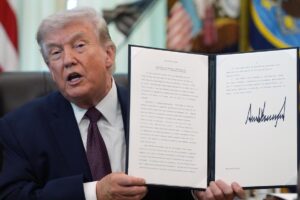
A federal judge in Washington, D.C. dealt a significant blow to the Trump administration’s election integrity agenda this week, ruling that a sweeping overhaul of a federal citizenship database violated multiple federal privacy laws. The decision blocks a tool that had already been used to screen more than 67 million voter registrations nationwide. President Trump responded with a wave of Truth Social attacks on the judge, keeping the constitutional fight over voter data squarely in the national spotlight this week.
Story Highlights
- U.S. District Judge Sparkle Sooknanan ruled the overhauled SAVE citizenship database violated the Privacy Act, Social Security Act, and Administrative Procedure Act
- At least 25 states had already screened roughly 67 million voter registrations through the system since April 2025
- The Justice Department has sued 30 states and Washington, D.C. seeking voter roll access and has lost every case so far
- Trump spent part of his weekend Truth Social posting spree attacking the judge, who was born in Trinidad and Tobago
What Happened
U.S. District Judge Sparkle Sooknanan issued a 75-page ruling ordering the Trump administration to stop using an overhauled version of the Systematic Alien Verification for Entitlements database, commonly known as SAVE, to screen voter registration rolls for noncitizens. The database, originally used since 1986 to verify immigration status for federal benefit eligibility, was expanded under a March 2026 executive order signed by President Donald Trump to incorporate Social Security Administration records, including Social Security numbers and citizenship data, into a centralized tool accessible to state election officials.
Sooknanan found that federal agencies acted unlawfully in building the expanded system, ruling that they violated the Privacy Act, the Social Security Act and the Administrative Procedure Act by failing to provide required public notice or comment periods before combining sensitive personal data. “The agencies were scrambling to comply with an Executive Order aimed at reshaping federal elections,” Sooknanan wrote, adding that officials “haphazardly combined and repurposed the private information of millions of Americans, including citizenship data that they knew to be unreliable.”
The ruling came in League of Women Voters v. Department of Homeland Security, a lawsuit brought by the League of Women Voters, the Electronic Privacy Information Center and five individual plaintiffs, represented by Democracy Forward, Citizens for Responsibility and Ethics in Washington, and the Fair Elections Center. According to court filings, at least 25 states, most led by Republican officials, had already run their full voter registration lists through the revamped SAVE system since April 2025, screening roughly 67 million registrations. Some states used the flagged results to open criminal investigations or cancel registrations, even though federal officials previously acknowledged that less than one percent of flagged records actually belonged to noncitizens.
The Justice Department, defending DHS in the case, has separately sued 30 states and the District of Columbia in an effort to compel them to turn over complete voter registration records for federal cross-referencing. That litigation campaign has produced no wins for the administration so far, with the U.S. Court of Appeals for the Sixth Circuit and multiple district courts, including in Michigan, Arizona, California, Maine, Maryland, Oregon and Rhode Island, ruling against the government’s requests. Trump responded to the SAVE ruling and its aftermath with an extended weekend social media campaign, sharing posts from allies criticizing Sooknanan and suggesting, according to reporting from The Independent, that her rulings were influenced by the fact that she was born outside the United States.
Why It Matters
The case sits at the intersection of two constitutional principles central to American self-governance: the right to vote and the right to privacy from unwarranted government data collection. Sooknanan’s ruling explicitly framed the dispute in those terms, writing that the case “implicates two fundamental rights that protect Americans from government overreach.” For a newsletter audience concerned with constitutional limits on executive power, the ruling illustrates how federal courts continue to serve as a check when an administration attempts to reshape election administration through executive action rather than legislation.
The practical stakes extend well beyond the courtroom. With at least 25 states having already used the flawed database to screen tens of millions of voters, and some jurisdictions using flagged results to purge registrations or launch investigations, the ruling raises serious due process questions for citizens who may have been wrongly targeted. Naturalized citizens and other lawfully registered voters whose records were mismatched against unreliable data faced the prospect of having their voting rights stripped without adequate notice or opportunity to contest the error, a scenario civil liberties advocates argue strikes at the heart of due process protections.
The administration’s continued legal campaign against 30 states, despite a perfect losing record in court so far, also raises questions about the use of federal litigation as a political pressure tool ahead of the November midterms. Critics argue that the pattern of executive action followed by defeat in court, followed by continued pressure campaigns, reflects an approach to governance that tests the boundaries of separation of powers, while the administration maintains it is simply enforcing constitutionally required citizenship requirements for federal elections.
Economic and Global Context
While the SAVE database dispute is not fundamentally an economic story, the litigation carries real costs for state governments, many of which have devoted staff time and resources to complying with federal requests for voter data or defending against DOJ lawsuits demanding access to registration records. States that already ran their rolls through the flawed system now face the administrative burden of reviewing and potentially reinstating registrations that were improperly flagged or removed.
The broader context includes a substantial federal investment in immigration enforcement infrastructure. Congress, through Trump’s signature spending legislation, doubled the number of ICE agents and increased the Department of Homeland Security’s budget by an additional 170 billion dollars over four years, funding that has supported the technological buildout of systems like the expanded SAVE database. Critics argue that directing this infrastructure toward voter roll screening, rather than exclusively immigration enforcement, represents a significant expansion of the database’s original statutory purpose.
Globally, the case has drawn attention from international observers and civil liberties organizations who monitor the use of centralized government databases for political purposes, a practice more commonly associated with authoritarian systems than established democracies. The scale of the data consolidation, merging Social Security records, immigration status and citizenship data into a single searchable federal tool, has prompted comparisons to data privacy debates unfolding simultaneously in the European Union and other democracies grappling with government data aggregation.
Implications
The ruling effectively halts the administration’s primary technological tool for its voter citizenship verification push, at least in its current form, though the Justice Department is expected to appeal. Given the administration’s consistent losses in related litigation across multiple circuits, any appeal faces significant headwinds, though the case could ultimately reach the Supreme Court given the stakes involved for the 2026 midterms.
For state election officials, particularly in Republican-led states that had integrated SAVE checks into their voter roll maintenance procedures, the ruling requires an immediate operational pivot, forcing a return to previous verification methods while the litigation continues. States that already purged voters based on flagged SAVE data may face pressure, and potentially further litigation, to review and reverse improper removals.
For voters, especially naturalized citizens and other lawfully registered Americans, the ruling offers a measure of protection against erroneous removal from the rolls heading into a pivotal midterm election. For Congress, the case underscores the ongoing debate over whether citizenship verification requirements should be established through legislation, such as the pending SAVE America Act, rather than executive action that federal courts have now repeatedly found exceeds statutory authority.
Sources
“Judge blocks Trump administration’s use of revamped immigration database to check voter rolls”
