
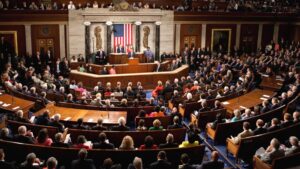
A major election integrity bill cleared the United States House of Representatives this week, setting up a high-stakes battle in the United States Senate that could define the contours of federal election law ahead of the 2026 midterms. The Safeguard American Voter Eligibility (SAVE) Act would require documentary proof of U.S. citizenship to register for federal elections and tighten verification standards for voter rolls. Supporters argue the measure strengthens constitutional safeguards around citizenship and ballot integrity; critics contend it risks administrative burdens and legal challenges. President Donald Trump has signaled support, framing the bill as part of a broader sovereignty agenda that includes border enforcement and institutional accountability. The House vote, largely along party lines, now shifts pressure to Senate leadership to decide whether to advance, amend, or block the proposal. With public confidence in elections a persistent political issue, the legislative trajectory of the SAVE Act carries strategic implications well beyond this session.
Story Snapshot
- House passed the SAVE Act requiring proof of citizenship for federal voter registration.
- Bill mandates updated verification standards for voter roll maintenance.
- Senate faces procedural hurdles, including filibuster thresholds.
- White House signals support, tying measure to broader election integrity priorities.
- Debate centers on constitutional authority, federalism, and access.
Federal Standards vs. State Authority
At the heart of the SAVE Act debate is the constitutional balance between federal oversight and state administration of elections. The Elections Clause grants Congress authority to regulate the “Times, Places and Manner” of federal elections, while states traditionally manage registration and procedures. Proponents argue that documentary proof of citizenship for federal registration falls squarely within Congress’s enumerated power to safeguard the integrity of federal contests.
Opponents counter that states already maintain mechanisms to verify eligibility and warn that imposing additional federal documentation standards could create compliance challenges. Civil liberties groups have raised concerns about potential administrative burdens, particularly for voters who lack immediate access to citizenship documents. Legal analysts expect any enacted version to face court scrutiny, likely focusing on the interplay between federal mandates and state systems.
For House Republicans, the measure responds to longstanding voter confidence concerns and provides a tangible policy achievement heading into campaign season. By codifying stricter standards at the federal level, sponsors argue they are reinforcing clarity and uniformity across jurisdictions.
Senate Math and Political Calculus
The SAVE Act’s path through the Senate is far from certain. With narrow margins and filibuster rules requiring 60 votes for most legislation, Republican leadership must decide whether to pursue bipartisan compromise or frame the bill as a messaging vehicle for election-year contrast.
Some senators have suggested targeted amendments that would phase in documentation requirements or provide federal grants to assist states with implementation. Others advocate advancing the House version intact to underscore commitment to election integrity, even if it stalls procedurally. The decision will test party unity and reveal how aggressively Senate leadership intends to push election-related reforms before November.
From a strategic standpoint, even a failed Senate vote could carry political resonance. By forcing recorded votes, sponsors may seek to clarify positions on documentation and citizenship verification, sharpening distinctions for voters concerned about election safeguards.
White House Framing and Midterm Impact
The White House has indicated that President Trump would sign the SAVE Act if it reaches his desk. In public remarks, administration officials have connected the proposal to a broader constitutional framework emphasizing citizenship, border enforcement, and institutional trust. The argument is that secure registration processes complement secure borders — reinforcing the legitimacy of federal elections.
Polls continue to show that a significant share of voters prioritize election security as a policy issue. For Republican candidates in competitive districts, backing the SAVE Act may serve as a signal of alignment with those concerns. Democrats, meanwhile, are expected to emphasize access and administrative feasibility, portraying the measure as potentially exclusionary.
The State of the Union address could provide a platform for Trump to highlight the House passage as evidence of legislative momentum. Whether framed as reform or restraint, the bill’s prominence underscores how election law has become a central battleground of governance debates.
Legal and Administrative Pathways
If the Senate advances the SAVE Act in any form, implementation would require coordination between federal agencies and state election offices. Funding mechanisms, documentation standards, and verification databases would all need clear statutory language to withstand judicial scrutiny. Election law experts note that precision in drafting will be essential to avoid ambiguities that courts could later invalidate.
Even without immediate enactment, the House vote places federal documentation standards squarely into the national conversation. State legislatures may independently revisit their own requirements, anticipating either federal alignment or continued divergence.
For constitutional scholars, the episode highlights the evolving nature of federal election authority. Each legislative attempt to standardize procedures tests the boundaries of federalism while reflecting contemporary political priorities.
What Comes Next
The Senate’s next steps will determine whether the SAVE Act becomes law, evolves through compromise, or stalls as a campaign issue. Committee hearings and procedural votes are expected in the coming weeks, with leadership gauging appetite for bipartisan negotiation.
For American governance, the stakes involve more than a single bill. The debate touches on citizenship verification, voter confidence, and the constitutional architecture of election oversight. As midterm campaigns intensify, how lawmakers position themselves on the SAVE Act may shape voter perceptions of institutional integrity.
Whether enacted or contested, the legislation underscores a broader strategic theme: the ongoing effort to define how federal authority intersects with state administration in safeguarding democratic processes. The Senate’s decision will signal how Congress intends to navigate that balance in the years ahead.
Sources
- House passes SAVE Act requiring proof of citizenship for federal voter registration, Associated Press, February 2026
- Republicans advance voter ID bill in House, setting up Senate fight, Reuters, February 2026
- Election law experts weigh legal questions around federal voter documentation standards, PBS NewsHour, February 2026
- How Trump will use his State of the Union address to highlight election priorities, Associated Press, February 2026
