
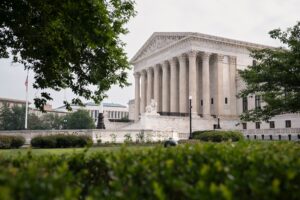
In a landmark 6-3 decision, the Supreme Court has overturned a 91-year-old precedent that shielded independent federal agencies from direct presidential control, handing President Trump the authority to remove officials at will from bodies Congress designed to operate free of White House interference. The ruling effectively dismantles Humphrey’s Executor, a 1935 case that has long served as a constitutional check on executive power over agencies like the Federal Trade Commission. Legal scholars say the decision marks one of the most significant expansions of presidential authority in modern history.
Story Highlights
- The Supreme Court ruled 6-3 along ideological lines to overturn Humphrey’s Executor, a 1935 precedent limiting presidential removal power over independent agency heads.
- The ruling directly affects agencies including the FTC, EEOC, Merit Systems Protection Board, and Consumer Product Safety Commission, where Trump has already removed Democratic appointees.
- The Federal Reserve’s independence remains intact for now after a separate 5-4 ruling allowed Governor Lisa Cook to stay in her position pending litigation.
What Happened
The Supreme Court, in a 6-3 decision, struck down Humphrey’s Executor v. United States, a 1935 ruling that had prevented presidents from removing at will the heads of independent agencies exercising quasi-legislative or quasi-judicial functions. Chief Justice John Roberts, writing for the majority, declared that “if anything more is left of Humphrey’s, the Court overrules it,” formally closing out nine decades of precedent that had shaped the structure of the modern administrative state.
The case originated from President Donald Trump’s removal of a Democratic commissioner from the Federal Trade Commission earlier in his second term, an action that lower courts initially blocked because it violated the agency’s statutory removal protections. Those protections trace back to the original 1935 case, in which the Supreme Court ruled that Congress could restrict President Franklin D. Roosevelt’s ability to fire an FTC commissioner who declined to support his New Deal agenda. Roberts distinguished the FTC and similar bodies from a narrow category of offices, such as non-Article III courts and the Federal Reserve Board of Governors, that he suggested may retain some insulation from presidential removal.
The ruling’s implications extend well beyond the FTC. Trump has already removed Democratic-appointed members from several other independent agencies, including the Equal Employment Opportunity Commission, the Merit Systems Protection Board, and the Consumer Product Safety Commission, actions that had been working their way through the lower courts under the assumption that Humphrey’s Executor remained good law. With the precedent now overturned, those removals, along with future ones, stand on much firmer constitutional footing.
Notably, the Court left the Federal Reserve’s independence intact for the moment. In a separate 5-4 ruling, the justices allowed Fed Governor Lisa Cook to remain in her position while related litigation continues in the lower courts, suggesting the central bank may occupy a special constitutional category distinct from other independent agencies, though the majority opinion did not definitively resolve the question for the long term.
Legal experts on both sides of the ideological spectrum have weighed in sharply. Rebecca Kelly Slaughter, the ousted FTC commissioner at the center of the case, has argued that agency independence allows decision-making “on the merits, about the facts, and about protecting the interests of the American people.” Attorneys who have represented Trump administration positions, by contrast, argue that congressional limits on presidential removal power were constitutionally suspect from the outset, since all executive power must ultimately trace back to a president accountable to voters.
Why It Matters
The ruling fundamentally reshapes the balance of power between the presidency and Congress with respect to the vast administrative apparatus that regulates much of American economic and civic life. For nearly a century, Congress has created dozens of agencies on the assumption that some degree of independence from White House political pressure would allow them to make decisions based on expertise and evidence rather than partisan considerations. That assumption has now been constitutionally undermined.
For ordinary Americans, the practical consequences could be significant. Agencies like the EEOC investigate workplace discrimination claims, the Consumer Product Safety Commission regulates the safety of everyday goods including children’s toys, and the FTC enforces antitrust and consumer protection law. Critics of the ruling warn that making these agencies directly answerable to the president risks politicizing enforcement decisions that were designed to be insulated from electoral cycles and White House priorities.
Constitutional scholars note that the decision represents a significant victory for the unitary executive theory, a legal framework favored by many conservative legal thinkers that holds all executive branch officials must be subject to presidential control. Proponents argue this restores constitutional accountability, since voters can only hold the president, not unelected agency officials, responsible through elections. Critics counter that the framework ignores the deliberate design choices Congress made when establishing these agencies to serve as checks on executive overreach.
The ruling also raises questions about the durability of other longstanding structural protections throughout the federal government, potentially inviting further litigation testing the boundaries of presidential removal power over other officials Congress has sought to insulate from direct political control.
Economic and Global Context
The decision arrives at a moment when several of the affected agencies are actively shaping economic policy. The FTC has pending antitrust matters against major technology and pharmaceutical companies, and a Federal Trade Commission more directly responsive to presidential priorities could shift enforcement priorities significantly depending on the administration’s relationships with specific industries or companies.
The narrower ruling protecting Federal Reserve independence, at least for now, carries substantial economic significance given the central bank’s role in setting monetary policy. Financial markets have historically placed a premium on central bank independence as a signal of credible, apolitical monetary policy, and any erosion of that independence could affect investor confidence in the long-term stability of U.S. financial markets, even though the Court has not yet extended its removal-power ruling to the Fed itself.
International observers have also taken note, as the decision touches on broader debates about executive power and checks and balances that resonate in discussions of democratic institutions globally. Foreign governments and international financial institutions often look to the independence of U.S. regulatory bodies, including the Federal Reserve, as a benchmark for institutional credibility, making the carve-out for the Fed a closely watched element of the ruling.
Implications
For federal agencies across the government, expect swift action from the Trump administration to test the boundaries of its newly affirmed removal power, particularly at agencies where Democratic-appointed officials remain in place. Agency heads at bodies like the National Labor Relations Board and other multimember commissions should anticipate similar legal challenges in the near future.
For Congress, the ruling significantly weakens its ability to structure agencies with built-in independence from the executive branch, a tool lawmakers have used for nearly a century to insulate technical and regulatory decisions from short-term political pressures. Future legislation creating new federal agencies will need to grapple with this diminished capacity to guarantee independence.
For businesses and consumers, the practical effects will likely unfold gradually as agency leadership changes translate into shifts in enforcement priorities, rulemaking, and regulatory posture. Companies operating in heavily regulated sectors should expect greater volatility in agency direction tied more closely to presidential transitions than has historically been the case.
Sources
“Supreme Court cements Trump’s power over agencies long considered independent”
