


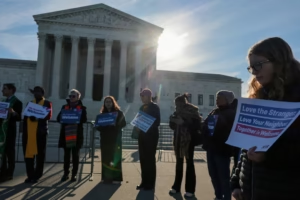
Story Highlights
The Supreme Court ruled 6-3 that asylum seekers do not “arrive in” the United States merely by approaching a port of entry while still in Mexico.
The ruling allows the Trump administration to revive “metering,” a policy limiting the number of asylum seekers processed each day, first used under the Obama administration.
Justice Sonia Sotomayor delivered a forceful dissent from the bench, while Justice Samuel Alito offered a rare on-the-record response.
What Happened
The Supreme Court ruled Thursday in favor of the Trump administration in a closely watched case testing the federal government’s authority to turn back asylum seekers before they formally cross the U.S.-Mexico border. Writing for the 6-3 majority, Justice Samuel Alito held that federal immigration law’s requirement that a person be “physically present” in the United States or have “arrived in the United States” to apply for asylum does not extend to migrants who present themselves to U.S. officials while still standing on Mexican soil. “A guest does not arrive in a house when he knocks on the front door,” Alito wrote, concluding that asylum protections under the Immigration and Nationality Act attach only once a person actually crosses into the country.
The ruling effectively revives the legal basis for “metering,” a practice first introduced in a more limited form under the Obama administration in 2016 and later expanded during Trump’s first term, under which U.S. Customs and Border Protection officers turn away migrants lacking valid travel documents when a port of entry is deemed to be at capacity. The Biden administration had rescinded the policy. A California-based federal judge previously found that metering violated the rights of asylum seekers and a legal requirement that they be screened for fear of persecution, a ruling a divided panel of the Ninth Circuit Court of Appeals affirmed, though nearly half the judges on the full court voted to rehear the case, a signal that ultimately drew the Supreme Court’s attention.
The Trump administration argued that the lower court’s interpretation deprived the executive branch of “a critical tool for addressing border surges and preventing overcrowding at ports of entry,” and the Court’s conservative majority agreed. The ruling reversed the Ninth Circuit panel majority, which had been composed of two Obama-appointed judges with a Trump-appointed judge dissenting, and which had previously concluded that the government’s preferred interpretation would render the law’s “physically present” and “arrives in” language redundant and amount to “a radical contraction” of asylum rights.
Justice Sonia Sotomayor delivered an unusually forceful dissent from the bench, the rare practice of reading a dissent aloud in the courtroom rather than simply filing it in writing, stating that the majority’s opinion “regrettably and tragically extinguishes the light of the torch of the Statue of Liberty.” Alito offered a direct response after Sotomayor finished speaking, an exchange court watchers described as unusually pointed for the typically reserved proceedings. The ruling marked the second major immigration victory for the administration that day, following a separate decision allowing the government to strip Temporary Protected Status from hundreds of thousands of Haitian and Syrian immigrants.
Why It Matters
This ruling fundamentally reshapes when asylum protections attach under federal law, a question with enormous practical consequences for the hundreds of thousands of migrants who annually seek protection at the southern border. By establishing that physical presence inside U.S. territory, rather than mere presentation at a port of entry, triggers asylum rights, the Court has given the executive branch substantially greater discretion to limit access to the asylum process without needing new legislation from Congress.
For migrants fleeing persecution, the practical effect could be significant: when metering was previously in place, advocates documented lines of thousands of people waiting for extended periods in often unsafe makeshift shelter conditions in Mexican border towns, since they were not formally permitted to set foot on U.S. soil and begin the asylum process. Humanitarian organizations have warned that reinstating the policy risks recreating those conditions and could push more migrants toward dangerous, unauthorized crossing routes between official ports of entry.
The ruling also has broader implications for the separation of powers between the courts and the executive branch on immigration policy. By finding that the relevant statutory language does not extend asylum protections to those who have not yet crossed the border, the Court has effectively endorsed a policy tool that several administrations, both Democratic and Republican, have used or sought to use, suggesting a degree of judicial deference to executive border management decisions that will likely shape future immigration litigation.
Economic and Global Context
The ruling carries consequences for border infrastructure, regional economies along the U.S.-Mexico border, and diplomatic relations between Washington and Mexico City. Metering, when previously implemented, created substantial strain on Mexican border communities, which absorbed large populations of migrants waiting for extended periods to be processed, placing pressure on local resources including shelter capacity, medical services, and law enforcement in cities such as Tijuana and Ciudad Juarez.
Internationally, immigrant rights organizations and humanitarian groups have criticized the decision as inconsistent with international refugee protection norms, which generally hold that individuals fleeing persecution should have meaningful access to seek protection regardless of administrative capacity constraints at any given entry point. The ruling could also affect diplomatic dynamics with Mexico, which has previously had to manage the humanitarian and security implications of large migrant populations concentrated near border crossings during past periods when metering was in effect.
Domestically, the decision arrives amid the Trump administration’s broader push to tighten immigration enforcement across multiple fronts simultaneously, including the TPS terminations for Haitians and Syrians announced the same day, an ongoing legal fight over courthouse arrests by immigration enforcement agents, and continued efforts to limit birthright citizenship. Together, these actions represent one of the most aggressive expansions of executive authority over immigration policy in recent decades, with this ruling providing a significant new legal foundation for border management practices going forward.
Implications
In the near term, the Department of Homeland Security is expected to move toward reinstating metering at ports of entry along the southern border, though the administration has not yet detailed a specific timeline or operational framework for doing so. Border policy experts anticipate that implementation details, including how capacity determinations will be made and communicated, will themselves become subjects of future litigation.
For asylum seekers and the attorneys who represent them, the ruling necessitates a significant shift in legal strategy, since the path to formally initiating an asylum claim may now depend heavily on the ability to physically cross the border rather than simply presenting oneself at an official entry point. Legal aid organizations operating in Mexican border communities are likely to see increased demand for guidance as affected populations navigate the changed legal landscape.
For Congress, the ruling may renew debate over whether legislative clarification of asylum law is needed, given the closely divided nature of the decision and the dissenting justices’ warnings about its humanitarian implications. Whether such legislation gains traction in a divided Congress focused on numerous other immigration-related fights remains uncertain, leaving the policy’s future shape largely in the hands of the executive branch for the foreseeable future.
Sources
“Supreme Court says U.S. can turn away asylum seekers at the border”
