
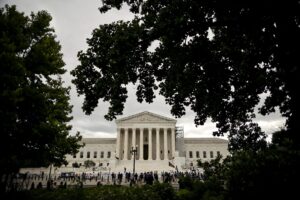
The Supreme Court delivered a landmark First Amendment ruling this week, striking down decades-old federal limits on how much political parties can spend in direct coordination with their candidates. The 6-3 decision, brought by Vice President JD Vance during his time as a Senate candidate, is expected to unleash a new wave of party spending ahead of the November midterm elections. The ruling continues an unbroken line of Supreme Court decisions since 2010 dismantling campaign finance restrictions on constitutional grounds.
Story Highlights
- The Supreme Court ruled 6-3 that federal limits on coordinated party campaign spending violate the First Amendment
- The ruling overturns a 2001 precedent, Federal Election Commission v. Colorado Republican Federal Campaign Committee
- Justice Brett Kavanaugh authored the majority opinion; Justices Sotomayor, Kagan and Jackson dissented
- Republican Party committees held 256 million dollars in cash with no debt as of late May, more than double Democratic committees’ holdings
What Happened
The Supreme Court ruled on June 30 in National Republican Senatorial Committee v. Federal Election Commission that federal limits on coordinated spending between political parties and their candidates violate the First Amendment’s free speech protections. The 6-3 decision, authored by Justice Brett Kavanaugh, overturned the Court’s 2001 ruling in Federal Election Commission v. Colorado Republican Federal Campaign Committee, which had upheld similar restrictions on a narrower 5-4 vote at the time.
The case originated in 2022, when then-Senate candidate JD Vance, then-Representative Steve Chabot of Ohio, and two Republican Party committees, the National Republican Senatorial Committee and the National Republican Congressional Committee, sued the Federal Election Commission, arguing that caps on coordinated campaign spending unconstitutionally restricted political parties’ ability to support their own candidates. Under the challenged provisions of the Federal Election Campaign Act, party committees faced coordinated spending limits ranging from 65,300 to 130,600 dollars for congressional campaigns and from 130,600 dollars to 4 million dollars for Senate campaigns, depending on state population, according to Federal Election Commission figures for the 2026 cycle.
Writing for the majority, Kavanaugh found that the restrictions could not be justified under the Court’s traditional anti-corruption rationale for campaign finance regulation, concluding that a political party coordinating with its own candidate does not present the same corruption risk as an outside donor seeking influence. “In short, constitutional text, history, and precedent establish that the political-party coordinated-expenditure limits violate the First Amendment,” Kavanaugh wrote, adding that the ruling “treats all political parties equally” and will allow the Republican National Committee, Democratic National Committee, and their respective congressional campaign arms to “participate more freely and compete more fully.”
Notably, the Trump Justice Department declined to defend the coordinated spending limits once the case reached the Supreme Court, prompting the justices to appoint outside attorney Roman Martinez to argue in defense of the restrictions, while separately granting the Democratic National Committee and its congressional campaign committees permission to intervene and argue for upholding the limits. Justices Sonia Sotomayor, Elena Kagan and Ketanji Brown Jackson dissented. Kagan wrote that the ruling “jettisons a rule needed to protect our democracy’s integrity” and would allow a political party “to serve as an alternative checking account for a campaign,” reviving the same corruption risks the original limits were designed to prevent following the Watergate scandal.
Why It Matters
The ruling represents a significant expansion of First Amendment protections for political spending, extending a line of jurisprudence that began with the Supreme Court’s 2010 decision in Citizens United v. FEC. For Americans concerned with the role of money in politics, the decision raises fundamental questions about how campaign finance law balances free speech rights against the government’s historic interest in preventing corruption and the appearance of corruption in federal elections.
The practical effect will be immediate and substantial. According to Federal Election Commission data, 2026 Senate candidates have already spent more than 490 million dollars ahead of the midterms, while House candidates have spent nearly 1 billion dollars, and those figures are expected to climb sharply now that party committees can coordinate unlimited spending directly with campaigns rather than operating through separate independent expenditure vehicles. Republican Party committees, including the Republican National Committee, held 256 million dollars in cash with no debt as of the end of May, more than double the roughly 126 million dollars held by their Democratic counterparts, who also carry more than 18 million dollars in debt, giving the party favored by the ruling a substantial near-term financial advantage.
For constitutional scholars, the ruling reinforces a broader jurisprudential trend of the Roberts Court treating campaign spending as core protected political speech, a framework that has consistently favored deregulation over the past decade and a half. Supporters argue the decision restores parties’ constitutional right to support their own nominees without arbitrary government-imposed ceilings, while critics warn it further concentrates political influence among the wealthiest donors capable of funding party coordination at scale.
Economic and Global Context
The ruling arrives at a moment when American political spending is already at historic highs, and campaign finance experts widely predict the decision will accelerate that trend heading into November. Because coordinated spending is typically used for television advertising, which is considerably cheaper when purchased jointly with a candidate’s own campaign rather than independently, party committees are expected to dramatically increase ad purchases in competitive House and Senate races across the country.
The decision fits within a broader twenty-year pattern of Supreme Court rulings unwinding campaign finance restrictions, beginning with Citizens United’s 2010 removal of limits on corporate independent expenditures, followed by the 2014 elimination of aggregate contribution limits in McCutcheon v. FEC, and now the removal of coordinated party spending caps. Political scientists note this trajectory has fundamentally reshaped how American elections are financed compared to the pre-2010 landscape, shifting influence increasingly toward large-scale institutional spenders.
Internationally, the ruling further distinguishes the American campaign finance model from most other developed democracies, many of which impose strict spending caps or provide public financing for political campaigns specifically to limit the influence of concentrated wealth in elections. Legal scholars monitoring global democratic institutions note that the United States now operates one of the most permissive campaign finance regimes among major democracies.
Implications
Party committees on both sides are expected to move quickly to take advantage of the ruling ahead of the November midterms, with Republican committees, currently holding a substantial cash advantage, likely positioned to benefit most immediately. Democratic committees, despite the disparity, are expected to ramp up coordinated fundraising efforts to remain competitive under the new framework.
For candidates in competitive districts and states, the ruling means campaigns can now work more closely with national party infrastructure on messaging and advertising without the previous statutory ceiling, potentially reducing campaigns’ reliance on outside Super PACs that operate independently and sometimes send conflicting messages. For voters, the practical effect will likely be a further increase in the volume of political advertising in contested races over the coming months.
For Congress, the ruling removes coordinated spending limits from the legislative toolkit entirely, meaning any future effort to regulate party-candidate coordination would need to identify a different constitutional basis than the anti-corruption rationale the Court has now twice rejected in this context, a challenge that campaign finance reform advocates acknowledge will be difficult to overcome under the current Court’s composition.
Sources
“Supreme Court strikes down limits on political party spending”
