


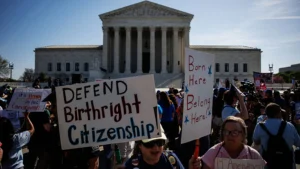
The Supreme Court has ruled that President Donald Trump’s executive order attempting to end birthright citizenship violates the Constitution, delivering a major defeat to one of his signature immigration initiatives. The 6-3 decision affirms that the 14th Amendment’s Citizenship Clause guarantees citizenship to nearly all people born on U.S. soil, regardless of their parents’ immigration status. The ruling marks the third significant Supreme Court setback for the administration in recent months and reaffirms a constitutional principle unchanged for over a century.
Story Highlights
- The Supreme Court ruled 6-3 that Trump’s birthright citizenship executive order violates the 14th Amendment
- The order, signed on Trump’s first day in office, sought to deny citizenship to children born to undocumented or temporary immigrants
- Legal experts say only a constitutional amendment, not ordinary legislation, could change the outcome
What Happened
President Trump signed the executive order on January 20, 2025, his first day back in the White House, seeking to deny automatic citizenship to babies born in the United States to parents who were in the country illegally or on temporary visas. The order represented a direct challenge to more than a century of settled constitutional interpretation and was blocked by every federal court that examined it before ever taking effect.
Writing for the majority, Chief Justice John Roberts traced the history of birthright citizenship from English common law through the ratification of the 14th Amendment in 1868 and the Supreme Court’s landmark 1898 decision in United States v. Wong Kim Ark, which affirmed the rule of citizenship by birth with narrow exceptions for children of foreign diplomats and occupying armies. “Citizenship, then and now, was the right to have rights, to freely participate in our political community,” Roberts wrote, adding that “the Framers of the Fourteenth Amendment extended that promise to every free-born person in this land.”
Five justices, including Roberts and Trump appointee Amy Coney Barrett, agreed the order violated the 14th Amendment directly. Justice Brett Kavanaugh wrote separately, concluding the order violated the Immigration and Nationality Act rather than the Constitution itself, but nonetheless joined the majority in striking it down. Justices Clarence Thomas, Samuel Alito, and Neil Gorsuch dissented, arguing the administration’s reinterpretation of the clause was permissible.
The ruling followed a tangled procedural history. After lower courts, including one led by U.S. District Judge Leo Sorokin in Boston, issued nationwide injunctions blocking the order, the administration asked the Supreme Court to narrow those injunctions to cover only the individual plaintiffs in each case. In Trump v. CASA, Inc., decided in June 2025, the court sided with the administration on that narrower procedural question, raising fears that hundreds of thousands of infants could be left in legal limbo. The merits of the underlying constitutional question were resolved only with this term’s final ruling.
Why It Matters
The decision preserves a bedrock constitutional guarantee that has defined American citizenship since Reconstruction. A Migration Policy Institute-Penn State study estimated that had Trump’s order taken effect, roughly 255,000 infants a year would have been born in the United States without citizenship, swelling the undocumented population by an estimated 2.7 million people by 2045. The ruling forecloses that outcome and reaffirms that citizenship in America is a birthright, not a policy choice subject to executive discretion.
For immigrant families and civil rights organizations, the ruling is being treated as a landmark victory. Cecillia Wang, an American Civil Liberties Union attorney who argued the case, said the decision reaffirms that a president cannot rewrite the Constitution through executive order alone. The case underscores a core separation-of-powers principle: that fundamental constitutional guarantees are not subject to unilateral revision by the executive branch, regardless of the policy rationale offered.
For Congress, the ruling narrows the path forward considerably. In the immediate aftermath, Trump urged lawmakers on Truth Social to pass legislation ending birthright citizenship, writing that “no long and unwieldy Constitutional Amendment is necessary.” But legal scholars, including several who track the court closely, have said that characterization misunderstands the ruling: because the majority grounded its decision in the constitutional text itself rather than merely statutory interpretation, only a formal constitutional amendment, ratified by three-quarters of the states, could alter the outcome.
That reality has already prompted a legislative response. Sen. Rand Paul of Kentucky acknowledged after the ruling that “if we want real, lasting change, it has to come through the amendment process,” while Sen. Eric Schmitt of Missouri introduced a constitutional amendment the same day that would limit birthright citizenship to children of U.S. citizens and permanent residents.
Economic and Global Context
The ruling has significant fiscal and administrative implications. Had the order taken effect, federal and state agencies would have faced the enormous logistical challenge of verifying parental immigration status for every American birth, a bureaucratic overhaul with substantial costs that several state attorneys general cited in their legal challenges. By affirming the status quo, the ruling avoids what immigration policy analysts had warned could become a chaotic, multi-decade tracking system affecting millions of births annually.
Internationally, the United States has long been among a group of nations, including Canada and most of Latin America, that grant unconditional birthright citizenship, a practice known as jus soli. The ruling keeps America aligned with that tradition, in contrast to most European nations, which generally require at least one parent to hold citizenship or legal residency, a system known as jus sanguinis.
The decision also arrives amid the administration’s broader immigration enforcement agenda, including expanded ICE operations and increased use of state National Guard units, meaning the birthright citizenship question remains just one front in a much larger legal and political battle over the scope of executive immigration authority.
Implications
For families directly affected, the ruling provides immediate legal certainty: children born on U.S. soil, regardless of their parents’ immigration status, remain citizens at birth, with no changes to hospital registration, Social Security enrollment, or passport eligibility procedures.
For the amendment push now underway in the Senate, the path remains exceedingly difficult. Constitutional amendments require two-thirds approval in both chambers of Congress and ratification by 38 states, a threshold no immigration-related amendment has approached in modern history.
For the administration, the ruling marks a pattern, following the February decision striking down Trump’s tariff authority and this term’s ruling limiting his power to fire a Federal Reserve governor, of a Supreme Court willing to constrain executive action even from a bench with a conservative supermajority that includes three Trump appointees.
For voters, the ruling will likely remain a live issue heading into the midterms, with immigration hardliners pressing for a constitutional amendment while civil rights advocates frame the decision as a necessary check on executive overreach.
Sources
“Supreme Court upholds birthright citizenship, striking down Trump’s order”
