


Story Highlights
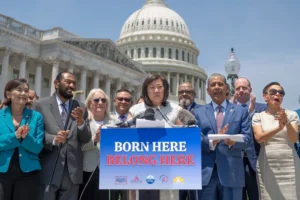
- The Supreme Court ruled 6-3 that Trump’s executive order ending birthright citizenship for children of undocumented or temporary immigrants is unconstitutional.
- Chief Justice John Roberts wrote the majority opinion, joined by Justices Barrett, Kavanaugh in part, Sotomayor, Kagan and Jackson.
- Justice Clarence Thomas wrote a 91-page dissent arguing the Fourteenth Amendment applied only to freed slaves and their descendants, prompting a rare rebuke from Justice Ketanji Brown Jackson.
What Happened
The Supreme Court ruled Tuesday that President Donald Trump‘s executive order seeking to end automatic citizenship for babies born on U.S. soil to parents who are undocumented or in the country temporarily is unconstitutional. Chief Justice John Roberts authored the 26-page majority opinion in the case, formally titled Trump v. Barbara, tracing the American practice of birthright citizenship through English common law, the ratification of the Fourteenth Amendment in 1868, and the Supreme Court’s own 1898 precedent in United States v. Wong Kim Ark. “Citizenship, then and now, was the right to have rights,” Roberts wrote, concluding that “the Framers of the Fourteenth Amendment extended that promise to every free-born person in this land.”
Roberts was joined by fellow conservative Justice Amy Coney Barrett along with the court’s three liberal justices, Sonia Sotomayor, Elena Kagan and Ketanji Brown Jackson. Justice Brett Kavanaugh filed a separate opinion concurring in the judgment but dissenting in part, writing that while he did not believe the executive order violated the Fourteenth Amendment directly, it did contravene a 1940 federal statute governing citizenship. He suggested Congress, not the president, holds the power to establish exceptions to birthright citizenship through legislation.
The order, signed by Trump on his first day back in office in January 2025, had sought to deny citizenship documents to babies born in the U.S. to parents who were undocumented or present only temporarily, effective 30 days after its signing. Multiple federal district courts and two appellate circuits had already blocked the order before the case reached the Supreme Court, which heard two hours of oral argument in April 2026.
The most striking split emerged in the dissents. Justice Clarence Thomas, joined by Justice Neil Gorsuch, wrote a 91-page dissent arguing the majority’s historical account was inaccurate and that the Fourteenth Amendment’s Citizenship Clause was originally intended as a narrow, race-specific remedy for freed slaves rather than a universal guarantee. Justice Samuel Alito wrote a separate dissent, calling the case “one of the most important decisions in the history of the Court” while arguing the majority “made a serious mistake.” Justice Jackson, joined by Sotomayor, wrote a pointed concurrence directly confronting Thomas, noting that despite his “longstanding endorsement of a colorblind Constitution,” he was now arguing the citizenship clause was a “race-conscious remedial measure.”
Why It Matters
The ruling reaffirms one of the most fundamental constitutional guarantees governing who counts as an American citizen, a principle that has anchored U.S. law since Reconstruction. Had the order been upheld, it would have marked the first time in over a century that the executive branch successfully redefined a core constitutional right through unilateral action rather than constitutional amendment or congressional legislation, a precedent civil liberties advocates warned could have opened the door to further executive overreach on other constitutional guarantees.
The unusual ideological alignment in the majority, with two conservative justices joining three liberal justices, signals that even a court reshaped by three Trump appointees was unwilling to endorse such a dramatic reinterpretation of settled constitutional text through executive fiat alone. That result offers a meaningful data point for Americans concerned about the durability of constitutional checks on presidential power, even under a court with a nominal conservative majority.
The internal debate between Thomas and Jackson over the amendment’s original meaning also reflects a deeper and ongoing struggle within American constitutional interpretation over how to read Reconstruction-era amendments, a debate with implications well beyond this single case for future disputes over civil rights, equal protection, and the scope of federal power.
For the roughly hundreds of thousands of children born annually to undocumented or temporarily present parents, the ruling settles, for now, questions about their legal status that had created significant uncertainty for families across the country since the order’s issuance.
Economic and Global Context
The ruling carries direct fiscal and administrative implications for federal and state agencies. Had the order taken effect, it would have required the Social Security Administration, state vital records offices, and numerous other agencies to overhaul systems for determining citizenship status at birth, an administrative undertaking that legal analysts estimated would have cost hundreds of millions of dollars and created significant backlogs.
Internationally, the decision is likely to be closely watched by other nations grappling with their own immigration and citizenship debates, given the outsized influence U.S. constitutional jurisprudence often holds on global legal discourse. Countries with jus soli citizenship traditions, including much of the Western Hemisphere, may point to the ruling as reinforcing the stability of birthright citizenship frameworks more broadly.
Domestically, the ruling arrives amid the broader immigration enforcement escalation underway across the administration, including expanded ICE arrest operations and stricter asylum policies, meaning the birthright citizenship question was one piece of a much larger legal and political battle over the scope of executive authority on immigration matters.
Legal scholars note the ruling leaves intact Kavanaugh’s suggestion that Congress could still legislate narrower citizenship exceptions, meaning the political fight over birthright citizenship is likely to shift toward the legislative arena even as the constitutional question has now been resolved by the Court.
Implications
The ruling closes, at least for now, one major avenue Trump had pursued to unilaterally reshape immigration policy through executive order rather than legislation, reinforcing the principle that fundamental changes to citizenship law require either constitutional amendment or congressional action. Immigration advocates and civil liberties organizations have hailed the decision as a critical check on executive overreach.
For Congress, Kavanaugh’s separate opinion effectively invites lawmakers to take up the citizenship question legislatively if they wish to narrow birthright citizenship, a path that would require overcoming the Senate’s 60-vote threshold for most legislation and is unlikely to advance given current partisan divisions.
For the Trump administration, the defeat is one of several recent setbacks in federal courts on immigration-related executive actions, though the administration has continued pursuing other avenues to intensify enforcement, including expanded ICE operations and new prosecutorial priorities targeting so-called birth tourism cases.
For voters and legal observers, the case offers a rare, clarifying moment in an era of frequent executive action, underscoring that even a reshaped Supreme Court will enforce hard limits on unilateral attempts to rewrite settled constitutional guarantees, a reassurance likely to resonate across the political spectrum heading into further legal battles over executive power.
Sources
Supreme Court upholds birthright citizenship on constitutional grounds
