
Story Highlights
- Trump told Cassidy to sit down during a lunch meeting with Senate Republicans after a dispute over the War Powers Resolution
- Cassidy, who lost his GOP primary after Trump endorsed his opponent, told reporters: “I make no apologies for standing up to the president”
- The meeting, which lasted more than an hour, was organized by Sen. Rick Scott rather than Senate Republican leadership, an unusual procedural break from tradition
What Happened
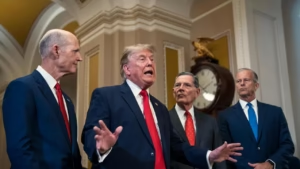
President Donald Trump traveled to Capitol Hill on Wednesday for a scheduled lunch with Senate Republicans, a meeting that turned contentious within minutes and left attendees describing scenes of raised voices and open confrontation. According to sources directly familiar with the events, Trump at one point sternly told Sen. Bill Cassidy of Louisiana to sit down after Cassidy pressed him on the War Powers Resolution and the administration’s conduct of the Iran war.
Cassidy, according to those accounts, had attempted to respond to the president with equal firmness, and at one point told Trump to sit down himself before ultimately relenting. “He raised his voice. I lost my temper. That’s not appropriate. It’s the Irish in me, but I again matched his tone and his volume,” Cassidy told reporters gathered outside following the meeting. He did not retreat from the substance of his position.
The Louisiana senator, who had voted the day before for a war powers resolution limiting Trump’s authority to continue military operations in Iran, made clear he was acting in the public interest regardless of political consequence. “I make no apologies for standing up to the president. I am sticking up for the American people, even if I’m speaking to the president,” Cassidy said.
The personal dimension of the confrontation adds additional weight. Cassidy did not advance to the runoff in Louisiana’s recent Republican Senate primary, a race in which Trump had backed his opponent. Trump pointedly highlighted this during the lunch, reminding Cassidy that his political career was effectively over — a rare and unusually personal note to inject into a policy dispute on the Senate floor. Cassidy, freed from the electoral calculus that constrains many of his colleagues, appeared undeterred.
The meeting itself was organized by Sen. Rick Scott of Florida rather than Senate Majority Leader John Thune or other members of formal leadership — an unusual break from standard protocol that multiple observers noted reflected the fragmented state of Senate Republican cohesion on Iran.
Why It Matters
The clash between Trump and Cassidy is significant not only as a personal confrontation but as a symbol of the broader accountability deficit that has emerged around the Iran conflict. Cassidy is raising questions that are constitutionally serious: whether the president has the authority to sustain a major military operation without formal congressional authorization, and whether lawmakers who hold that view can speak it openly without White House retaliation.
The fact that Cassidy spoke out despite losing his primary — indeed, perhaps in part because of it — illustrates how the electoral threat that has kept many Republican senators in line with Trump may have diminishing returns once members are no longer running. A senator with nothing to lose politically may be the only senator willing to ask hard questions in a room with the president present.
This dynamic matters for democratic governance more broadly. Congressional oversight of executive military power depends on individual members being willing to confront presidents of their own party. If that willingness exists only among senators who have been defeated or are retiring, the institutional check on executive war-making authority is significantly weakened in practice.
For the Republican Party heading into the midterms, the public spectacle of a presidential shouting match with a senator in a private caucus lunch creates a messaging challenge. The lunch was supposed to project party unity and presidential leadership. Instead, it produced headlines about raised voices, mutual admonishments, and a wounded senator telling reporters he had no regrets about confronting the commander in chief.
Economic and Global Context
The meeting took place against the backdrop of ongoing ceasefire negotiations between the United States and Iran in Switzerland, where Vice President JD Vance had recently concluded talks described as laying a “good foundation” for a final agreement. Any perception of domestic political chaos or a divided executive-legislative relationship carries implications for those negotiations, as foreign counterparts monitor American political stability closely.
Markets have remained sensitive to signals from Washington about the conflict’s trajectory. Oil prices have stayed elevated since the February 28 commencement of operations, with traders watching both the military situation and the diplomatic track for signals about supply disruptions. Political instability within the American governing coalition tends to add a risk premium to energy markets.
The meeting also occurred one day after the Senate passed a historic war powers resolution rebuking Trump’s handling of the conflict, a vote that Trump said had complicated his position at the negotiating table. Senate Republicans who had supported that resolution were specifically subjects of Trump’s anger during the lunch, with the Cassidy confrontation being the most visible expression of that frustration.
Within the Republican Party, defense hawk senators including Sen. Roger Wicker, Sen. Tom Cotton, and Sen. Ted Cruz have separately objected to the terms of the June 17 memorandum of understanding with Iran, arguing it is too lenient. That puts the caucus in the unusual position of experiencing dissent from both directions: members who believe the war was a mistake and members who believe the ceasefire terms are insufficient.
Implications
For Cassidy personally, the public confrontation represents a final assertion of institutional independence before he departs the Senate. His willingness to speak candidly in the room with Trump and then describe the encounter to reporters in unvarnished terms sets a standard that other senators may quietly admire but publicly avoid.
For Senate Republicans more broadly, the episode sharpens a choice they will need to make as the midterms approach: whether to maintain uniform deference to the White House on Iran or to begin staking out more independent positions that could appeal to voters who have grown skeptical of the conflict. Polling has consistently shown that the Iran war is unpopular with the American public.
For the White House, the meeting’s deterioration into open conflict is a political cost that will need to be managed. A president seen publicly berating a senator in a closed lunch that nonetheless produced detailed news accounts faces questions about temperament and coalition management at a time when legislative priorities like the SAVE America Act still require Senate cooperation.
For American governance, the episode underscores the stress the Iran conflict has placed on the traditional relationship between the executive and legislative branches, a stress that will not resolve itself until either the war ends or Congress develops a more durable mechanism for oversight.
Sources
Trump has testy meeting with GOP senators, telling Cassidy at one point to sit down
