Story Highlights
- Trump posted on Truth Social that Iran has “fully and completely agreed to highest level Nuclear inspections long into the future (Infinity!!!)”
- Iran’s Foreign Ministry denied any inspection agreement had been reached, stating no IAEA visit has been scheduled
- Trump warned that without Iranian compliance on inspections, “there would be no further negotiations”
What Happened
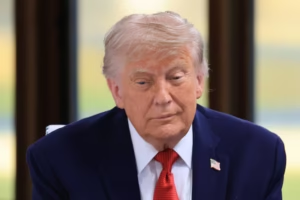
President Donald Trump took to Truth Social on Tuesday morning to forcefully insist that Iran had agreed to submit to sweeping nuclear inspections as part of the emerging framework to end the U.S.-Iran war. “Despite their protestations and false statements to the contrary,” Trump wrote, Iran had “fully and completely agreed to highest level Nuclear inspections long into the future.” He added that the inspections would ensure what he called “Nuclear Honesty” and issued a blunt warning: if Iran had not agreed, “there would be no further negotiations.”
The dispute broke into the open the day prior, when Vice President JD Vance told reporters following the first round of talks in Switzerland that Iran had agreed to allow the International Atomic Energy Agency back into the country. Vance called the first day of negotiations “very, very good” and said the two sides had laid a solid foundation for a final agreement. He cautioned, however, that trust would be earned through actions rather than words. “My point is that I trust actions,” Vance said.
Iran’s Foreign Ministry spokesperson Esmail Baghaei categorically rejected those claims. He told reporters in Tehran that no IAEA visits had been scheduled and that real negotiations on the nuclear issue had not yet formally begun. The IAEA itself did not respond to requests for comment, though the agency has previously been granted intermittent access to Iran since Israel’s conflict with the country in 2025, without being allowed into the bombed enrichment sites specifically targeted by the United States.
Separately, Trump announced he would not reimpose the U.S. naval blockade of the Strait of Hormuz, citing Iran’s purported concession on inspections as justification. He also said Iran’s frozen funds would be placed in escrow, allowing the country to purchase American corn, wheat, and soybeans. Secretary of State Marco Rubio departed for the Gulf region to brief U.S. allies, including the United Arab Emirates, Kuwait, and Bahrain, on the status of negotiations.
The backdrop to Tuesday’s dispute is a 60-day negotiating window established under a memorandum of understanding signed on June 17 by Trump and Iranian President Masoud Pezeshkian. The U.S. Treasury simultaneously waived sanctions on Iranian oil and gas sales through August 21, 2026, giving Tehran an immediate financial boost while diplomacy unfolds.
Why It Matters
The question of nuclear inspections is not a procedural detail — it is the central pillar of any credible non-proliferation agreement. The IAEA has historically been the mechanism by which the international community verifies whether a country is pursuing nuclear weapons. Without unfettered access to Iran’s bombed enrichment facilities, there is no independent way to confirm the current state of that program or assess how close Tehran may be to weaponization.
The public contradiction between American and Iranian accounts of what was agreed is a troubling early sign for the 60-day negotiating process. When the two sides cannot agree on whether a foundational commitment was made, it casts doubt on the durability of whatever framework eventually emerges. Critics of the memorandum, including several Republican senators, have warned that Iran has a long record of delay tactics in nuclear diplomacy.
For American voters and taxpayers who supported Trump’s military posture toward Iran, the inspections question directly shapes how they evaluate the terms of any deal. The administration has argued the memorandum is performance-based, meaning Iran gains no lasting benefits without verified compliance. If Tehran stonewalls inspectors, that standard becomes meaningless.
The stakes extend beyond nuclear policy. The Strait of Hormuz carries roughly 20 percent of global oil traffic, and Trump’s decision to keep it open is contingent on continued Iranian cooperation. Any breakdown in talks could quickly reintroduce the threat of a naval blockade with immediate and severe consequences for energy markets worldwide.
Economic and Global Context
The waiver of U.S. sanctions on Iranian oil and gas exports has already begun to affect energy markets. Iran’s return to global oil markets, even temporarily, adds additional supply at a time when markets have been rattled by months of military conflict in the Middle East. Analysts had previously estimated the Strait blockade alone was adding a significant risk premium to oil futures.
The Pentagon has separately told senators it needs approximately $80 billion in supplemental funding, mostly to cover the cost of the U.S. military campaign against Iran. That figure represents a significant addition to an already elevated defense budget and adds to fiscal pressure on Congress as lawmakers debate the administration’s broader budget reconciliation package.
Israel’s position adds another layer of complexity. Prime Minister Benjamin Netanyahu has publicly committed to maintaining Israeli forces in southern Lebanon regardless of the U.S.-Iran framework, a stance that threatens to complicate the ceasefire architecture. Trump responded to questions about Netanyahu by saying the situation would “get solved,” without elaborating.
The talks in Switzerland coincide with renewed fighting in Lebanon, where Hezbollah and Israeli forces have clashed despite ceasefire agreements. A new round of Israel-Lebanon negotiations opened in Washington on Tuesday, aimed at establishing a durable political and security framework.
Implications
If the inspections dispute is not resolved early in the 60-day window, it will likely harden congressional opposition to the memorandum. Lawmakers skeptical of the deal have pointed to Iran’s history of nuclear brinkmanship as reason to demand concrete verification before offering any sanctions relief. A protracted argument over the terms of agreed terms would give those critics substantial ammunition.
For Trump, the outcome of these negotiations carries significant political weight. The president has staked considerable personal credibility on the deal, framing the war-ending framework as a historic achievement. A collapse of talks, or a deal that fails to verifiably constrain Iran’s nuclear ambitions, would expose the administration to sustained criticism heading into midterm season.
For Iran, the economic incentive to reach a deal is real. The temporary oil sanctions waiver is providing financial relief, but a permanent lifting of sanctions requires a comprehensive agreement. Tehran must weigh whether the domestic political cost of accepting intrusive inspections is outweighed by the economic benefits of normalized trade.
The IAEA’s role will become clearer in the coming days. Whether inspectors are formally invited into Iran’s nuclear sites by the end of the week, as Vance suggested was possible, will serve as the first concrete test of whether the foundational elements of this agreement are real or aspirational.
Sources
“Trump insists Iran has agreed to nuclear inspections in talks for war-ending deal”
