Story Highlights
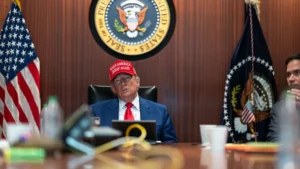
- Trump entered the Situation Room on May 29 to decide whether to approve a tentative Iran ceasefire extension deal
- Key U.S. demands include Iran surrendering its highly enriched uranium and permanently renouncing nuclear weapons
- Iran’s IRGC fired warning shots at vessels near the Strait of Hormuz on the same morning, complicating negotiations
What Happened
President Donald Trump took to Truth Social early Friday morning to announce he was heading to the White House Situation Room to make a “final determination” on the state of negotiations with Iran. The announcement came after U.S. and Iranian negotiators reported reaching a tentative memorandum of understanding to extend the existing ceasefire and restore free maritime passage through the Strait of Hormuz — but neither side’s leadership had formally signed off on the text.
The conflict itself dates to February 28, when Trump announced the launch of “major combat operations” against Iran, commencing joint U.S.-Israeli strikes targeting military, government, and infrastructure sites across the Islamic Republic. Following the strikes, Trump declared a two-week ceasefire and extended it indefinitely while a U.S. naval blockade remained in effect. As of May 29, U.S. Central Command confirmed that 115 commercial vessels had been redirected under the blockade, which has prevented commerce from entering or leaving Iranian ports since April 13.
In his Truth Social post, Trump outlined his non-negotiable conditions for approving any deal. Iran must commit to never developing a nuclear weapon or bomb, the Strait of Hormuz must be opened immediately without tolls or restrictions on shipping traffic in either direction, and all sea mines must be cleared from the waterway. Trump also stated that Iran’s stockpile of highly enriched uranium would be “unearthed by the United States” and destroyed in coordination with Tehran. He further specified that no financial relief or sanctions removal would be granted to Iran until further notice.
Treasury Secretary Scott Bessent separately warned Oman — which has been mediating talks — that the U.S. would “aggressively target” any party involved in facilitating a tolling system for Strait of Hormuz transit. Trump himself had earlier threatened at a Cabinet meeting to “blow up” Oman if it sided with Iran on the toll issue. Meanwhile, Iran’s parliamentary speaker Mohammad Bagher Ghalibaf posted a veiled but aggressive statement suggesting Iran’s concessions come from military leverage rather than diplomacy, complicating the prospect of a swift agreement.
Iranian state media, citing sources close to the negotiating team, said the text of any agreement had “not yet been finalized or made definitive,” and that Iran had not yet informed Pakistani mediators that the text was settled. Iran’s IRGC navy also fired warning shots at four vessels near the Strait of Hormuz on Friday morning, citing those ships’ failure to coordinate passage — a move that added further tension as Trump was weighing his decision in the Situation Room.
Why It Matters
The potential deal carries enormous implications for American foreign policy, national security, and the constitutional question of presidential war powers. Trump launched military operations against Iran without a formal congressional authorization for the use of military force, a point that has drawn bipartisan concern on Capitol Hill. Any agreement he now approves would similarly be executed at executive discretion, sidestepping the legislative branch in one of the most consequential foreign policy actions in decades.
For Americans, the most immediate domestic concern is energy prices. The Strait of Hormuz is a chokepoint through which a significant portion of the world’s oil supply passes. Its closure since the conflict began has contributed to global oil market volatility, raised inflation concerns, and strained supply chains. A genuine, verified deal that reopens the strait would provide tangible relief to American consumers paying elevated fuel and goods prices.
The deal’s terms also set a precedent for how the United States handles nuclear proliferation under Trump’s second term. Trump has been explicit that any agreement must be demonstrably stronger than the 2015 Joint Comprehensive Plan of Action, the Obama-era nuclear deal from which he withdrew during his first term. By demanding that Iran’s highly enriched uranium be physically removed and destroyed, Trump is seeking a more concrete and verifiable outcome than what the 2015 deal provided.
The credibility of Trump’s deal-making posture is also at stake. If Iran walks back the tentative agreement or disputes its terms — as Iranian state media’s cautious language suggests — it could force Trump to choose between resuming military strikes or accepting a weaker arrangement than publicly promised.
Economic and Global Context
The ongoing U.S.-Iran conflict and blockade have already had measurable effects on global shipping and energy markets. European stock markets rose on Friday in anticipation that a deal could be finalized, reflecting investor confidence that restored Hormuz access would stabilize oil prices. The disruption has been felt across Asia, Europe, and the Americas, as shipping routes and energy contracts have been recalibrated around the assumption of continued Persian Gulf uncertainty.
New U.S. sanctions on Iran’s oil trade, announced simultaneously by the State Department and Treasury Department on Thursday night, added a layer of complexity. The imposition of additional economic pressure during active negotiations signaled that the Trump administration intended to maximize leverage even as a deal appeared close, but it also risked hardening Iranian resistance at a critical juncture.
Globally, reaction to the potential deal has been mixed. Allies in Europe and the Gulf have cautiously welcomed any diplomatic resolution that ends hostilities and restores shipping access. China, which condemned the initial U.S. strikes on Iran as a violation of international law, has a major economic stake in Hormuz passage, importing substantial volumes of Iranian and Gulf oil. Beijing’s posture throughout the conflict has been adversarial toward U.S. actions while expressing formal support for dialogue.
The blockade itself, now stretching past six weeks, has already begun reshaping trade flows in ways that may not be fully reversible. Insurers have adjusted war-risk premiums, shipping companies have established alternative routing protocols, and several long-term energy contracts have been renegotiated.
Implications
If Trump approves the tentative deal, the immediate outcome would be an extended ceasefire, a lifting of the U.S. naval blockade, and the beginning of nuclear talks under a framework Trump has characterized as superior to prior agreements. Markets would likely respond positively, oil prices could ease, and diplomatic pressure on the administration from congressional critics would temporarily subside.
However, Iran’s posture entering Friday’s Situation Room deliberations was far from fully compliant. The IRGC’s warning shots near the Strait on Friday morning, combined with the parliamentary speaker’s defiant statement, suggest that Iranian hardliners remain resistant to the terms Washington demands. Any deal that reaches Trump’s desk for approval will face scrutiny from his own national security team, with Secretary of State Marco Rubio having publicly insisted Iran must surrender its enriched uranium and abandon any nuclear program before any sanctions relief is possible.
For voters and liberty-minded Americans, the constitutional dimension of this conflict deserves ongoing attention. Trillions in potential liability, military deployments, and geopolitical commitments have been undertaken without a formal war declaration or congressional authorization. The outcome of the Situation Room deliberations on May 29 may determine whether the United States is heading toward a durable, verifiable peace or a prolonged and legally contested military engagement.
The broader lesson for American policymakers is that major combat operations, once initiated, create momentum that is difficult to manage or contain. The Strait of Hormuz deal — if completed — would be a consequential executive achievement; if it fails, the path back to military escalation is shorter than many Americans may realize.
