


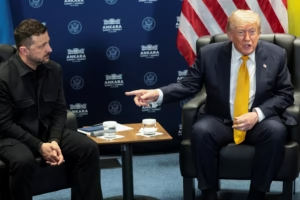
President Trump announced at the NATO summit that Ukraine will be granted a license to manufacture Patriot air defense missiles, with Lockheed Martin set to build a new production facility in Europe. The decision addresses a long-standing request from Ukrainian President Volodymyr Zelenskyy as Russia continues intensive missile and drone attacks against Ukrainian cities.
Story Highlights
- Trump confirmed Ukraine will receive a license to manufacture Patriot missiles domestically, with Lockheed Martin building a European production plant
- The announcement came during a joint press conference with Zelenskyy at the NATO summit in Ankara
- Russia launched 94 long-range strike drones and two ballistic missiles at Ukraine overnight, killing two people in Kharkiv
What Happened
During a joint news conference with Ukrainian President Volodymyr Zelenskyy on the sidelines of the NATO summit, President Donald Trump confirmed that the United States would license Ukraine to manufacture Patriot air defense missiles rather than continuing to rely solely on American-supplied stockpiles. “We’re going to give a license to you to make Patriots,” Trump told reporters. “That’s pretty cool, right? This way he can’t complain that we’re not giving them enough. I said, make them yourself.” Trump later specified that defense contractor Lockheed Martin would construct the manufacturing facility in Europe, marking a significant shift in how Ukraine’s air defense needs will be met going forward.
The announcement responds directly to a request Zelenskyy has repeated for months, as Ukraine has struggled to keep pace with the volume of Russian ballistic missiles targeting its cities and infrastructure. Patriot systems remain among the most effective defenses against these attacks, but demand has consistently outstripped the supply the United States and its allies have been able to provide from existing production lines, which are also servicing American and other allied military requirements.
The timing underscored the urgency of the request. Russia launched a fresh wave of attacks on Wednesday night into Thursday morning, firing 94 long-range strike drones and two ballistic missiles at targets across Ukraine, according to Ukraine’s Air Force. While Ukrainian defenses jammed or intercepted 72 of the drones, 19 drones and at least one missile struck their targets. Local officials reported that missiles struck the city of Kharkiv, killing two people and injuring dozens more. Ukrainian forces also struck back, with drones setting two Russian oil tankers ablaze in the Sea of Azov and hitting additional Russian oil facilities, while Russia’s Defense Ministry said its air defenses downed 73 Ukrainian drones over the same period.
Despite the continued fighting, Trump expressed cautious optimism about prospects for eventual peace negotiations. When Zelenskyy was asked whether he would ever travel to Moscow for direct talks, Trump interjected with skepticism about the prospect, saying, “I don’t know that he’d go to Moscow.” The exchange reflected the continued distance between the warring parties on any framework for direct negotiations, even as both the United States and European allies continue searching for pathways toward a durable ceasefire.
Why It Matters
The decision to license domestic Patriot production in Ukraine represents a structural shift in how the United States approaches Ukraine’s air defense needs, moving from a model of direct transfers to one of localized manufacturing capacity. This approach could reduce the strain on American production lines while giving Ukraine greater long-term self-sufficiency in defending its airspace, a critical factor as the war shows no sign of near-term resolution.
For American taxpayers and policymakers, the shift toward licensed production rather than direct military aid transfers may also reshape the political debate over continued support for Ukraine. Framing the arrangement as enabling Ukraine to “make them yourself” allows the administration to continue supporting Kyiv’s defense needs while addressing domestic political sensitivities around the scale and duration of direct American military assistance.
The move also has implications for NATO’s broader defense industrial base. Building Patriot production capacity in Europe, rather than solely in the United States, could strengthen allied manufacturing capabilities more broadly, an outcome consistent with NATO’s ongoing efforts to increase European defense spending and production self-sufficiency amid the extended conflict with Russia.
For Ukraine, the license offers a pathway toward greater strategic autonomy in its own defense, reducing dependence on the pace and availability of American supply decisions that have fluctuated throughout the war. It also sends a signal to Moscow that Western support for Ukraine’s air defense is shifting toward a more durable, long-term footing rather than remaining contingent on continued transfers from existing stockpiles.
Economic and Global Context
The Patriot missile system, produced by Lockheed Martin and Raytheon, has become one of the most sought-after defense exports globally given its demonstrated effectiveness against ballistic missile threats. Establishing a European production facility represents a substantial capital investment and is likely to create manufacturing jobs across the facility’s host country while strengthening the broader transatlantic defense industrial relationship.
Global defense spending has risen sharply since the war in Ukraine began, and NATO allies have faced consistent pressure from Washington to increase their own contributions to collective defense budgets. The Patriot manufacturing announcement aligns with this broader trend, potentially serving as a model for other allied nations seeking to build domestic or regional production capacity for advanced weapons systems rather than depending entirely on American supply chains.
The continued Russian strikes on Ukrainian oil and energy infrastructure, alongside Ukraine’s retaliatory strikes on Russian oil facilities and tankers in the Sea of Azov, also carry implications for global energy markets, as both sides target infrastructure that affects regional and, at times, global fuel supplies.
Implications
Construction of the Lockheed Martin facility will likely take considerable time before Ukraine sees meaningfully increased domestic missile production, meaning the near-term impact on the battlefield will be limited. In the interim, Ukraine will continue to rely on existing Patriot stockpiles and allied transfers to defend against ongoing Russian missile and drone attacks.
For NATO allies, the announcement may prompt discussion of similar arrangements for other critical defense systems, particularly as the alliance continues pushing member states toward greater self-sufficiency in defense production. European governments hosting or considering similar facilities will need to weigh the economic benefits against the diplomatic and security complexities of expanded weapons manufacturing on their soil.
For the war’s broader trajectory, the Patriot licensing deal signals continued, if evolving, American commitment to Ukraine’s defense even as Trump simultaneously voices skepticism about the near-term prospects for a negotiated peace, suggesting the conflict is likely to continue for the foreseeable future.
Sources
