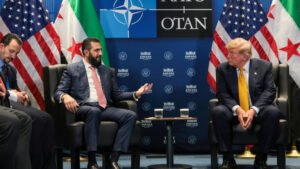
President Trump has formally initiated the process to remove Syria from the U.S. list of state sponsors of terrorism, a designation the country has held since 1979. The decision, delivered directly to Syrian President Ahmed al-Sharaa during the NATO summit in Ankara, marks one of the most significant shifts in American policy toward Damascus in nearly five decades.
Story Highlights
- Trump notified Congress of his decision to rescind Syria’s terrorism designation, triggering a 45-day congressional review period
- The move follows Trump’s June 2025 executive order lifting most sanctions on Syria and comes after “formal assurances” from al-Sharaa against supporting terrorism
- Once finalized, only Iran, North Korea, and Cuba will remain on the State Department’s terrorism sponsor list
What Happened
President Donald Trump met with Syrian President Ahmed al-Sharaa on the sidelines of the NATO summit in Ankara and informed him directly that he had decided to remove Syria from the State Department’s list of state sponsors of terrorism. “I promised to remove all barriers stopping you from rebuilding your country, and very soon, you will finally be able to do so,” Trump wrote in a letter handed to al-Sharaa following their meeting, according to a senior U.S. administration official. Trump added that “U.S. companies ready to invest in Syria” would help the country’s economic recovery.
Secretary of State Marco Rubio formally notified Congress of the decision on Wednesday, triggering a 45-day review period before the rescission can take effect. In a statement, Rubio called the move “yet another historic step by President Trump to give the Syrian people a chance at greatness,” and said it followed “positive changes and counterterrorism actions” taken under al-Sharaa’s government, along with formal assurances that Syria would not support international terrorism going forward. The designation, which has restricted foreign assistance, defense exports, and financial transactions with Syria, was first imposed in 1979 under Hafez al-Assad, making it the longest-standing designation of its kind for any country.
The decision represents a striking turnaround given al-Sharaa’s own background. He previously commanded al-Qaeda’s Nusra Front in Syria before severing ties with the group in 2016, later leading a coalition of Islamist rebel factions that toppled the Assad regime in December 2024. Trump praised al-Sharaa extensively during their meeting, saying he was “respected by everybody, including me,” and crediting him with unifying the country after decades of civil war and repression under the Assad family.
The move builds on a series of steps the administration has taken over the past year to normalize relations with Damascus. Trump signed an executive order in June 2025 terminating the broader U.S. sanctions program on Syria, and the United Nations Security Council adopted a U.S.-led resolution in November lifting sanctions on al-Sharaa personally, enabling his first official visit to the White House. Congress subsequently repealed the Caesar Syria Civilian Protection Act in December, removing another major layer of sanctions. A bipartisan group of lawmakers, including Democratic Senators Jeanne Shaheen and Elizabeth Warren alongside Republican Representative Joe Wilson, had urged Rubio in a letter earlier this month to complete the delisting, arguing the legal grounds for the designation no longer applied.
Why It Matters
The delisting removes one of the last major barriers preventing Syria’s full reintegration into the global financial and economic system after nearly 14 years of civil war. For ordinary Syrians, the designation’s removal could open the door to substantially greater international investment, banking access, and trade relationships that were previously legally risky for foreign companies, particularly American firms, to pursue.
The decision also carries significant implications for U.S. counterterrorism strategy in the region. Trump suggested Syria could help the United States confront Hezbollah, the Iran-backed militant group in Lebanon, noting that al-Sharaa has already severed Syria’s prior relationships with both Hezbollah and Russia, including ending Russian military presence at bases in Latakia and Tartus. This repositioning of Syria from adversary to potential partner represents a substantial realignment of American strategy in the Middle East at a moment when tensions with Iran are simultaneously escalating.
For Congress, the 45-day review period offers an opportunity for lawmakers to examine whether al-Sharaa’s government has made sufficient progress on human rights, minority representation, and security guarantees before the designation formally lifts. While a bipartisan trio of lawmakers has pushed for delisting, other members have raised concerns that al-Sharaa’s government still has considerable work ahead on issues including equal representation for women and religious and ethnic minorities within Syria.
Israel’s concerns add another layer of complexity. Trump had previously pressed for Syria to normalize relations with Israel as a condition of closer American engagement, yet proceeded with the delisting despite what observers describe as a lack of tangible progress on that front, a decision that could strain coordination with Washington’s closest Middle East ally at a sensitive moment.
Economic and Global Context
Removing the terrorism designation is expected to substantially increase the pace of foreign investment in Syria’s reconstruction. Saudi Arabia and other Gulf states have already signaled plans for billion-dollar investments to support Syria’s recovery, and Syria’s central bank governor said the delisting would open wider avenues for investment and reintegration into the global economy. American companies, previously barred from operating in Syria due to legal risk, will now have a clearer path to enter the market.
The move also reflects a broader pattern of the Trump administration’s Middle East diplomacy, which has emphasized economic normalization as a tool for stabilizing former conflict zones. Coming just one day before the administration ordered fresh military strikes against Iran, the Syria decision illustrates the administration’s willingness to pursue starkly different approaches toward different regional actors based on assessed behavior and strategic value.
Globally, once finalized, the delisting will leave only Iran, North Korea, and Cuba on the State Department’s roster of state sponsors of terrorism, underscoring how significantly the designation’s scope has narrowed as diplomatic relationships shift across the Middle East.
Implications
Over the coming 45 days, Congress will conduct its review, and while significant opposition is not currently expected, lawmakers concerned about Syria’s human rights record or the pace of political inclusion could attempt to slow or challenge the rescission. Barring that, the designation is expected to lift on schedule, opening the door to expanded American business activity in Syria.
For the broader region, the decision may accelerate Syria’s economic recovery and strengthen al-Sharaa’s domestic standing as he works to consolidate control following the civil war, though questions remain about the durability of his government’s commitments on counterterrorism and human rights. American policymakers will likely monitor Syria’s follow-through closely, given the reversibility of the designation should conditions change.
For investors and businesses, the delisting represents a notable, if still cautious, opening in a market that has been largely closed to Western capital for nearly five decades, with reconstruction needs across infrastructure, energy, and housing sectors offering significant long-term opportunity.
Sources
“Trump says he’ll remove Syria as state sponsor of terrorism for the first time since 1979”
