

Story Highlights
- The order reclassifies roughly 8,000 senior policy-influencing positions into Schedule Policy/Career
- Affected employees can now be removed without traditional civil service protections
- The order builds on Executive Order 13957 from Trump’s first term
What Happened
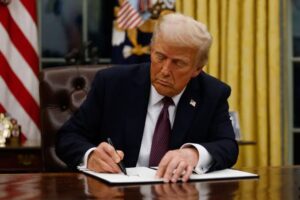
President Donald Trump signed an executive order this month titled “Increases Accountability in the Federal Workforce,” which reclassifies approximately 8,000 senior federal positions that influence policy decisions into a new category known as Schedule Policy/Career. Under this classification, affected employees remain technically nonpartisan career officials but lose many of the procedural protections that traditionally shield civil servants from termination, becoming removable at will by agency leadership.
The White House has framed the order as a continuation of efforts begun during Trump’s first term, when Executive Order 13957 first attempted to reclassify senior policy-related positions as at-will employees. That earlier effort was rescinded by the Biden administration before taking full effect, making this new order effectively a second attempt to implement the same structural change to federal employment law.
According to the administration’s fact sheet, the order does not alter the nonpartisan hiring processes or competitive status associated with these roles, and officials say removal decisions are intended to be made without respect to political affiliation. However, the practical effect is that employees in Schedule Policy/Career positions can now be dismissed for “poor performance, misconduct, corruption, or subversion of Presidential directives” without the lengthy procedural hurdles that have historically protected career civil servants from removal.
The order builds on a broader series of workforce policy changes implemented over the past 18 months, including a new Civil Service Rule XI requiring agencies to affirmatively determine whether probationary employees warrant retention rather than allowing default tenure, expedited removal procedures for serious misconduct, and a streamlined reduction-in-force process managed through the Office of Personnel Management. The administration has also offered buyout programs encouraging federal employees to leave voluntarily as part of what officials describe as an effort to “drain the swamp” and reduce the size of the federal bureaucracy.
The White House has cited internal polling suggesting that a plurality of senior federal employees in Washington said they would disregard a lawful presidential order they considered bad policy, despite all executive branch employees formally reporting to the president. Officials pointed to instances during Trump’s first term in which career employees reportedly declined to assist with policy initiatives related to civil rights enforcement and Title IX reform due to personal disagreement with the administration’s approach.
Why It Matters
This executive order represents one of the most consequential structural changes to the federal civil service in decades, with implications that extend well beyond the current administration. By stripping traditional job protections from thousands of senior policy positions, the order fundamentally alters the balance of power between elected political leadership and the permanent, nonpartisan bureaucracy that has historically provided continuity across changing administrations.
Supporters argue the change restores democratic accountability by ensuring that officials implementing presidential policy can be held responsible for performance and compliance, consistent with the constitutional principle that elected leaders should be able to direct the executive branch they were chosen to lead. They contend that career employees who actively resist lawful directives undermine the ability of voters to see their electoral choices translated into policy outcomes.
Critics, including many former civil servants and government reform advocates, warn that removing job protections from policy-influencing positions risks politicizing roles that were specifically designed to remain insulated from partisan pressure, potentially discouraging qualified professionals from joining or remaining in government service. They argue the change could erode institutional expertise and create a chilling effect where officials prioritize political loyalty over independent professional judgment.
For American taxpayers, the long-term consequences depend heavily on implementation. Proponents suggest improved accountability could reduce waste and improve government efficiency, while critics warn that high turnover among experienced senior staff could result in costly institutional knowledge loss and disrupted continuity in complex policy areas like national security, public health, and economic regulation.
Economic and Global Context
The federal workforce changes arrive amid a broader restructuring of government operations that has included substantial reductions in federal employment through buyouts and reorganization efforts. Economists who study public sector labor markets note that significant turnover among senior federal officials can carry economic costs that are difficult to quantify immediately but tend to manifest over multi-year periods through reduced institutional capacity and slower regulatory processing times.
The order also has implications for how foreign governments and international institutions interact with the U.S. government, given that senior policy officials in agencies handling trade, diplomacy, and national security often serve as continuity points across changing political administrations. Increased turnover in these roles could affect the consistency of U.S. positions in ongoing international negotiations, including the trade framework agreements currently being finalized with multiple global partners.
Federal employee unions and professional associations have indicated they expect to pursue legal challenges similar to those that complicated implementation of the original 2020 version of this policy, which never fully took effect before being rescinded. Litigation could delay or limit the practical scope of the reclassification, particularly regarding which specific positions ultimately qualify under the new Schedule Policy/Career designation.
Within Washington’s policy community, the order has reignited longstanding debates about the appropriate balance between democratic accountability and professional independence in government, a tension that has shaped civil service reform discussions since the Pendleton Act first established merit-based federal hiring in 1883.
Implications
Implementation will likely unfold gradually, as agencies work to identify which specific positions meet the criteria for reclassification under Schedule Policy/Career. The Office of Personnel Management is expected to issue detailed guidance clarifying the scope of affected roles in the coming months.
For federal employees in potentially affected positions, the order creates immediate uncertainty about job security, which experts warn could accelerate voluntary departures from government service even before formal reclassification decisions are finalized for specific roles.
For congressional oversight committees, the order is likely to generate hearings and information requests, particularly from Democratic lawmakers concerned about the precedent it sets for future administrations of either party to reshape civil service protections through executive action rather than legislation.
For voters, the long-term significance will depend on how the policy is ultimately implemented and whether legal challenges succeed in narrowing its scope, with the broader debate over the size, structure, and accountability of the federal government likely to remain a central theme through the 2026 midterm elections and beyond.
Sources
“President Donald J. Trump Increases Accountability in the Federal Workforce”
