
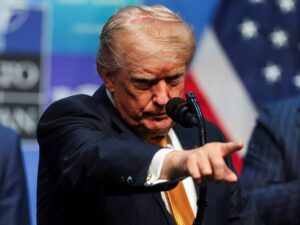
President Donald Trump declared this week that the Supreme Court’s ruling upholding birthright citizenship is “absolutely insane” and announced he will formally ask the justices to reverse the decision. The statement sets up a renewed constitutional confrontation over the 14th Amendment just weeks after the nation’s highest court struck down his executive order in a decisive ruling.
Story Highlights
- Trump called the Supreme Court’s birthright citizenship ruling “absolutely insane” and said he’ll seek a rehearing
- The Supreme Court struck down Trump’s executive order in a decision written by Chief Justice John Roberts
- A federal judge in New Hampshire has since issued a preliminary injunction protecting affected children
- The ruling reaffirmed 128 years of precedent stemming from the 1898 Wong Kim Ark decision
What Happened
President Trump used a social media post to announce his intention to formally request that the Supreme Court reverse its recent ruling upholding birthright citizenship, calling the decision “absolutely insane.” The declaration comes after the high court, in a decision authored by Chief Justice John Roberts, struck down Trump’s executive order seeking to deny automatic citizenship to children born in the United States to parents who are in the country illegally or on a temporary basis.
In the ruling, Trump v. Barbara, Roberts wrote for the majority that children born in the United States to parents unlawfully or temporarily present in the country satisfy both elements of the Constitution’s Citizenship Clause and are citizens at birth under the 14th Amendment. The chief justice traced the legal reasoning back to the Supreme Court’s 1898 decision in United States v. Wong Kim Ark, which held that the Citizenship Clause incorporated common law principles guaranteeing citizenship to nearly all children born on American soil, a rule the Court noted it has “repeatedly understood” to apply consistently for 128 years.
The ruling followed an earlier decision in Trump v. CASA, in which the justices held 6-3 that lower courts lack authority to issue nationwide injunctions blocking federal policies. That earlier ruling had temporarily complicated efforts to challenge Trump’s order on a national scale, prompting continued litigation in lower courts even after the CASA decision. Following the Supreme Court’s later ruling striking down the order itself, a federal judge in New Hampshire, Joseph Laplante, issued a preliminary injunction blocking enforcement of the order against a class of babies born after February 20, 2025, who otherwise would have been denied citizenship, concluding the order “contradicts the text of the Fourteenth Amendment.”
Trump’s push for reversal now sets the stage for an unusual scenario in which the administration seeks to have the same Supreme Court revisit a ruling it issued only weeks earlier, a request legal scholars describe as exceedingly rare and unlikely to succeed absent a significant change in the Court’s composition or a fundamentally new legal theory.
Why It Matters
The birthright citizenship fight strikes at one of the most fundamental questions of American constitutional law: who qualifies as a citizen at birth. The 14th Amendment’s Citizenship Clause has stood as settled law for over a century, and the Supreme Court’s decisive rejection of Trump’s executive order reaffirmed that only Congress, through a constitutional amendment, holds the authority to alter that guarantee, not the executive branch through unilateral order.
For the millions of American families with mixed immigration status, the practical stakes are significant. Had Trump’s order been allowed to stand, it would have created a class of children born on U.S. soil without automatic citizenship, a dramatic departure from more than a century of settled practice that immigration law experts warned could have produced significant legal and administrative chaos.
The case also illustrates the ongoing tension between the executive branch’s expanding assertions of authority and the judiciary’s role as a check on that power. Even as the Supreme Court has sided with Trump on other separation-of-powers questions this term, including expanding his authority to remove officials from independent agencies, the birthright citizenship ruling represented a clear limit the Court was unwilling to cross.
Constitutional scholars note that Trump’s request for a rehearing, while unlikely to succeed, keeps the issue in the public conversation and could be paired with legislative efforts, such as a recently introduced House bill dubbed the Birthright Citizenship Clarification Act, aimed at codifying restrictions through statute rather than executive order.
Economic and Global Context
Birthright citizenship policy carries direct implications for labor markets, healthcare systems, and social services that rely on stable determinations of legal status for children born domestically. Hospitals, school districts, and state benefit programs have all built administrative systems around the assumption that children born in the U.S. are citizens, and any disruption to that framework would require significant regulatory and administrative overhaul.
Internationally, the United States is among roughly 30 countries, mostly in the Western Hemisphere, that follow the principle of unrestricted jus soli, or birthright citizenship. Comparisons to European nations, most of which use more restrictive citizenship frameworks tied to parental status, have featured prominently in political debate, even though such comparisons do not directly bear on the constitutional question before American courts.
The broader legal battle also intersects with immigration enforcement trends nationally, as ICE arrest numbers have surged in recent months, raising the practical stakes for families navigating both citizenship status questions and heightened enforcement activity simultaneously.
Implications
A formal rehearing request would need to demonstrate compelling grounds under Supreme Court rules, a high bar that legal experts say Trump’s team is unlikely to clear given the decisive nature of the original ruling and its grounding in longstanding precedent. Most rehearing petitions are denied without significant deliberation.
For congressional Republicans, the renewed push may reinvigorate legislative efforts to address birthright citizenship through statute, though any such law would likely face its own constitutional challenges given the Supreme Court’s recent affirmation of the 14th Amendment’s plain text.
For families currently protected by the New Hampshire injunction, the practical effect of Trump’s rehearing request is limited in the near term, though continued litigation and political rhetoric around the issue are likely to persist as a defining feature of immigration policy debates heading into the 2026 midterms.
Sources
