


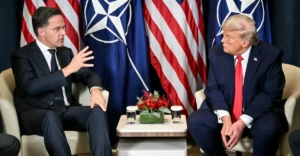
Story Highlights
- Trump ordered 5,000 troops withdrawn from Germany and said cuts will go “way down,” extending well beyond the initial announcement.
- The Pentagon separately canceled a deployment of approximately 4,000 additional troops that had been planned for Poland.
- A 2026 defense law bars the Pentagon from reducing troop levels in Europe below 76,000 for more than 45 days without congressional notification and a national security certification.
What Happened
President Donald Trump announced in early May 2026 that the United States would withdraw 5,000 troops from Germany over the following six to twelve months, a decision the Pentagon described as the result of a thorough review of U.S. force posture in Europe. The announcement shocked European governments that had not been consulted and had recently received assurances from U.S. NATO Permanent Representative Matthew Whitaker that any adjustments would be coordinated with allies to prevent strategic gaps.
Speaking to reporters in Florida the following day, Trump made clear the Germany withdrawal was only the beginning. “We’re going to cut way down,” he said. “And we’re cutting a lot further than 5,000.” He offered no specific numbers or timeline, but the statement signaled a potential restructuring of the entire U.S. military footprint in Europe — which currently includes roughly 36,000 troops in Germany, 13,000 in Italy, and approximately 4,000 in Spain.
The Pentagon subsequently canceled a separate deployment of approximately 4,000 troops to Poland that had been planned in advance, according to reporting by the Washington Post on May 15. That cancellation came without formal coordination with Warsaw and added to the perception among European governments that the U.S. was withdrawing from commitments that had underpinned NATO’s deterrence posture against Russia.
Trump’s frustration with European allies traces directly to the Iran conflict. When he called on NATO partners to send warships to help open the Strait of Hormuz, France, Spain, and the United Kingdom declined to give American forces free use of their bases or airspace for Iran-related operations. Spain blocked its territory and airspace for such missions. When German Chancellor Friedrich Merz publicly criticized the war effort, saying the United States was being “humiliated” by Iran’s negotiating tactics, Trump reacted with particular intensity, and the German troop announcement followed days later.
Several senior Republican lawmakers on the Armed Services Committee — including Sen. Roger Wicker and Rep. Mike Rogers — issued a joint statement expressing alarm, warning that the withdrawal could send “the wrong signal to Vladimir Putin” and undermine American credibility during Russia’s ongoing invasion of Ukraine.
Why It Matters
The potential scale of a U.S. military drawdown in Europe would represent the most significant restructuring of American force posture on the continent since the Cold War’s end. NATO deterrence has long rested on the credibility of the American security guarantee — the principle that an attack on one member is an attack on all. A significant withdrawal of U.S. forces, particularly during active conflict in the Middle East and continued Russian aggression in Ukraine, challenges that credibility in ways that are difficult to reverse quickly.
Section 1249 of the National Defense Authorization Act for fiscal year 2026 establishes legal limits on the administration’s ability to act unilaterally. Under that provision, the Pentagon cannot use its budget to reduce troop levels in Europe below 76,000 for more than 45 days unless it certifies that the cuts serve U.S. national security interests, consults NATO allies, and submits a detailed report to Congress. The current drawdown falls above that threshold, giving the administration room to maneuver — but Trump’s statement that cuts will go “way down” raises the question of whether the administration intends to push toward the statutory floor.
Analysis from the Council on Foreign Relations flags that the troop numbers alone do not capture the full significance of the situation. More consequential may be the possible cancellation of Tomahawk cruise missile deployments to Germany that had been planned for 2027, and the depletion of U.S. weapons stockpiles caused by the Iran conflict. These factors together erode the foundations of NATO deterrence in ways that go beyond any single troop count.
Economic and Global Context
The geopolitical reverberations of a sustained U.S. military drawdown in Europe are significant for global markets and security architecture. European governments have been accelerating their own rearmament programs in response to prior signals from the Trump administration about reduced U.S. commitment to NATO. Germany is on track to reach NATO’s 3.5 percent of GDP defense spending target by 2029 — a goal that Trump himself had championed. The timing of the withdrawal announcement, after Germany increased its defense commitments, was widely described as perplexing by European analysts.
Oil markets are sensitive to any development that affects the reliability of U.S. military presence in the broader Middle East and European theater simultaneously. A perception that American power is being retrenched on multiple fronts could affect risk pricing in energy markets and sovereign debt markets in affected countries, particularly in Eastern Europe where Russia’s threat is most immediate.
For the United States, the economic cost of any major redeployment is also relevant. Defense analysts have noted that moving forces out of Germany’s established infrastructure — including Ramstein Air Base and Landstuhl Regional Medical Center — and replicating those capabilities elsewhere would be enormously expensive and logistically complex, likely running into the billions of dollars.
Implications
The immediate next step is a period of intense diplomatic activity. NATO Secretary-General Mark Rutte downplayed the announcement, suggesting that European nations had “heard a message” and were working to strengthen bilateral basing agreements. But European capitals from Warsaw to Madrid are reassessing their dependence on U.S. security guarantees, and several have accelerated timelines for their own defense buildups.
For Congress, the question is whether the administration’s “way down” language will eventually trigger the statutory consultation and certification requirements of the 2026 NDAA. If Trump moves toward the 76,000 threshold or below, Congress will likely respond — and the Republican members of the Armed Services Committee who have already signaled concern could become an important check on further reductions.
For American voters, the Europe troop decision adds to a crowded foreign policy debate that already includes the unresolved Iran conflict and stalled nuclear negotiations. The strategic coherence of simultaneously drawing down in Europe while prosecuting a war in the Persian Gulf is a question that will occupy military analysts, congressional overseers, and allied governments for months to come.
Sources
“Trump signals deeper Europe troop cuts beyond 5,000, setting up fight with Congress”
