
Story Highlights
- Tucker Carlson apologized on his podcast for having “misled” people into voting for Trump, saying he would be “tormented by it for a long time”
- The feud reignited in earnest following joint U.S.-Israeli military strikes on Iran in February 2026, with Carlson calling Trump a “slave to Israel” in his newsletter
- Some of Trump’s own Supreme Court appointees have separately questioned the president on key constitutional cases, deepening a broader pattern of tension with former allies
What Happened
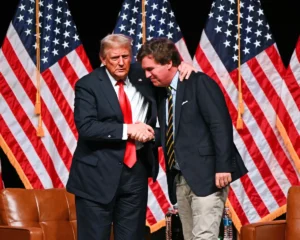
The Trump-Carlson feud refers to the ongoing public dispute between U.S. President Donald Trump and conservative media personality Tucker Carlson, a former Fox News host and podcaster. Once close political allies, the two have engaged in escalating public clashes primarily rooted in disagreements over U.S. foreign policy — particularly the American military intervention in Iran — and Carlson’s accusations that Trump had betrayed the America First movement he campaigned on. Wikipedia
Carlson, who had been one of Trump’s most prominent media backers throughout the 2024 presidential campaign, began criticizing the administration’s foreign policy direction as early as June 2025. After a brief reconciliation, the feud resumed in earnest following joint U.S.-Israeli strikes on Iran in February 2026, leading Carlson to publicly denounce the president in unusually harsh terms. In April 2026, Carlson apologized on his podcast for having “misled” supporters into voting for Trump, calling the moment a cause for personal torment. Wikipedia
The former allies traded sharp public statements, with Carlson calling Trump a “slave” to Israel and apologizing for “misleading” people into voting for him in 2024. “I do think it’s, like, a moment to wrestle with our own consciences. We’ll be tormented by it for a long time — I will be. And I want to say I’m sorry for misleading people,” Carlson told his brother on an episode of his show. HuffPost
Carlson repudiated Trump as a “slave to Israel” in his morning newsletter, the latest rhetorical escalation in a growing public feud between the podcaster and the commander-in-chief. Carlson lambasted Trump for comments he made in a Sunday interview with Fox News host Maria Bartiromo, in which the president condemned the Iranian regime for its reluctance to accept American conditions. Algemeiner
Carlson insisted he never suggested President Trump could be “the Antichrist,” despite a recording proving he had. During a nearly two-hour interview with The New York Times, host Lulu Garcia-Navarro pressed Carlson on his commentary about Trump, specifically whether he had suggested the president could be the Antichrist. “I have not said that,” Carlson replied, before Garcia-Navarro read back Carlson’s own words from a broadcast of his show. The Daily Beast
Why It Matters
Carlson’s break with Trump is more than a media feud. For years, Carlson served as the most prominent translator of Trump’s political instincts to a mass conservative audience — articulating the populist, anti-interventionist, and culturally traditionalist themes that defined the America First brand. His defection, and his apology to his own viewers, represents a rupture with that narrative that cannot be easily patched. When one of the movement’s most credible voices tells his audience he misled them, the question of what he actually sold them becomes unavoidable.
The substantive disagreement between the two men centers on constitutional war powers and foreign entanglements — issues with deep roots in the American conservative tradition. Non-interventionism, skepticism of executive war-making power, and distrust of permanent entanglements in foreign conflicts have long been central to one strand of American conservatism. Carlson’s position aligns with that tradition; the administration’s actions align with the neoconservative hawkishness that the same movement spent years criticizing. The resulting tension is ideologically genuine, not merely personal.
For Americans skeptical of executive overreach, the foreign policy dimension of the Carlson-Trump split raises legitimate constitutional questions. The United States military engaged in strikes on Iran without explicit congressional authorization — a pattern of executive military action that has been criticized across the ideological spectrum. Carlson has made that criticism loudest from the right, giving voice to a significant constituency within the conservative base that is deeply uncomfortable with open-ended military commitments.
The feud also illustrates the fragility of movements built around a single personality. When Trump and Carlson aligned, their combined audience was enormous and mutually reinforcing. That alignment suppressed internal debate about the direction of the movement. With the alliance broken, those debates are now public and unresolved — a shift that has real implications for the cohesion of the Republican coalition as midterms approach.https://youtu.be/tox2hr4dddM
Economic and Global Context
The Iran conflict at the heart of the Carlson-Trump split carries direct economic consequences that touch every American household. The closure of the Strait of Hormuz has driven energy prices higher, contributing to inflation pressure that has persisted through the first half of 2026. Carlson’s critique focuses not just on the foreign policy judgment involved but on the material cost to ordinary Americans of military adventurism that he argues serves interests other than theirs.
That argument resonates with the working-class voters who formed a central part of Trump’s coalition — voters who experience rising gas prices and grocery costs directly and who are skeptical of the political establishment’s explanations for why American military force is deployed overseas. Carlson has channeled that skepticism explicitly, framing the Iran engagement as a departure from the economic nationalism that he and Trump had jointly promoted.
More broadly, fractures in the conservative media ecosystem have market consequences. Carlson’s audience, which numbers in the millions across his podcast and newsletter, represents a discrete constituency that now receives political commentary sharply critical of the president. Advertisers, donors, and political operatives are all recalibrating their strategies in response to that realignment — a process with downstream effects on the funding and messaging infrastructure of American conservatism.
Implications
For Trump, the Carlson feud presents a dual challenge. In the short term, it provides an articulate, credible voice that frames the administration’s foreign policy as a betrayal rather than a success — a narrative that could complicate the midterm message. In the longer term, it demonstrates that the America First brand is contested intellectual territory, not a stable coalition that the president controls.
For the conservative movement broadly, the split is an opportunity to clarify what America First actually means. The movement has always contained competing impulses — hawkish national security views and non-interventionist populism, free trade and economic nationalism, constitutionalist restraint and executive power expansion. The Carlson-Trump feud has made those tensions visible in a way that forces voters and commentators to choose which tradition they actually support.
For Carlson personally, the split carries reputational risk. His public apology has divided his audience, with some viewers praising his candor and others viewing it as a destabilizing act of political irresponsibility. How he navigates the next phase of his commentary — and whether he finds a coherent political alternative to the movement he helped build — will determine his long-term influence in American political life.
Sources
“Tucker Carlson Says He Doesn’t ‘Hate’ Trump, But Feels ‘Betrayed'”
